A closer look
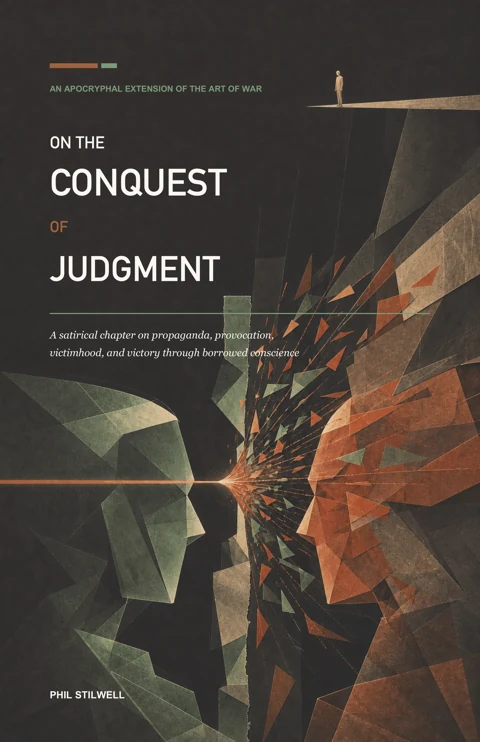
On the Conquest of Judgment adopts the compressed, strategic voice of The Art of War to examine a different kind of battlefield: the audience deciding what a conflict means. This is a modern satirical extension, not a lost ancient chapter or a translation. Its imagined strategist explains how the judgments of people far from the fighting can supply legitimacy, support, and influence.
The unsettling perspective is deliberate. By describing manipulation from the manipulator’s viewpoint, Phil Stilwell makes its methods easier to recognize. A weaker belligerent may exploit a stronger opponent’s restraints, while distant witnesses may carry a partisan account precisely because they understand themselves as independent and compassionate. The satire asks what turns genuine concern into borrowed judgment.
Thirteen movements through the machinery of persuasion
The illustrated sections examine how a propagandist prepares an audience: rewarding quick verdicts, attaching claims to identity, and replacing an examination of evidence with a test of allegiance. Other movements show how false conclusions can be attached to genuine facts, how a story’s chosen beginning can conceal a provocation, and how accusations can be redirected instead of answered.
The book also considers competitive victimhood—the contest to make one group’s suffering eclipse another’s—and the use of moral language to make inquiry seem cruel. It follows these methods into repetition, institutional amplification, and the possibility that manufactured messages eventually distort the judgment of those producing them.
What the satire does and does not excuse
No nation, religion, or ethnic group is named. The subject is a recurring method of influencing an audience, and readers are asked to apply the scrutiny across allegiances. Real suffering does not become unreal because its presentation is selective. Discovering deceit by one side does not make another side innocent.
That distinction keeps the book’s concern with evidence connected to its concern for people. Compassion need not operate as a competition, and acknowledging a victim need not require accepting every claim made in the victim’s name. The strategic voice exposes exploitation of these pressures rather than recommending it.
From literary strategy to habits of judgment
The author’s afterword connects the literary devices to research on provocation, misinformation, emotional sharing, identity, repeated messaging, and competitive victimhood. It also explains how fabricated evidence can give a liar a second advantage: an excuse to dismiss genuine evidence as fabricated.
The closing movement turns toward practical habits: tracing reports to their sources, checking chronology, separating observation from inference, comparing explanations, and saying what would change one’s mind. Readers of political satire, media criticism, and the psychology of belief will find a compact work designed for close reading. Its challenge includes the reader’s preferred side; critical thinking becomes useful only when it remains active under that pressure.
Ready to turn the page?
Find this book on Amazon