A closer look
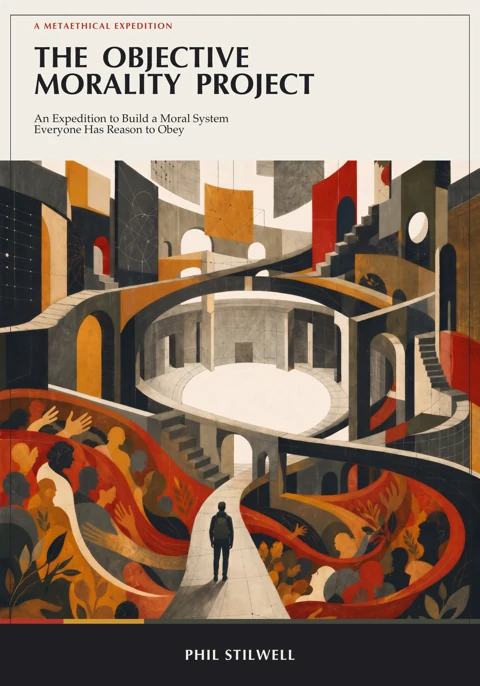
The commission in Port Meridian begins with an ambitious assignment. Before it can produce a complete system, however, its members must establish something more modest: whether even one moral reason can bind someone who lacks the relevant concern. An irreplaceable recording, a hidden opportunity, and a burden that could easily be relieved turn that abstract question into situations the participants must examine together.
The result is a philosophical expedition conducted through sustained dialogue. Advocates develop proposals; critics identify gaps; replies sometimes require a revised argument rather than a quick victory. The fictional people and events are deliberately constructed to isolate questions. Readers encounter a dispute about the foundations of moral judgment, with attention to the difference between finding an argument incomplete, having grounds to reject it, and showing that its conclusion is impossible.
Three attempts to establish objective reasons
One proposal begins with human welfare and asks whether moral properties could be natural properties of lives and circumstances. Another begins with agency, our capacity to choose and act, and investigates what choosing commits us to respecting in ourselves and others. A third asks whether some reasons may be basic rather than derived from a deeper foundation. Each approach must explain how it reaches an indifferent person, not merely why its conclusion appeals to those who already share the relevant commitments.
Testing what an additional moral foundation explains
A fourth proposal develops moral non-realism: an account of evaluation without moral grounding independent of every evaluative standpoint. Its central test is explanatory sufficiency. If facts about suffering, relationships, human capacities, and reflective commitments already explain criticism and correction, what does a realist interpretation add, or what independent argument supports it? Stilwell’s eventual preference is for moral anti-realism. He presents that preference as open to stronger arguments, rather than treating the commission’s difficulty as proof that every possible moral realism is false.
Keeping practical and philosophical claims distinct
The inquiry separates a reason from the motivation to act, an obligation from permission to enforce it, and a claim’s truth from our ability to know it. It also investigates disagreement and whether the evolutionary history of a belief undermines its credibility. Someone’s indifference does not erase another person’s suffering or others’ reasons to intervene; those protective reasons do not automatically become the indifferent person’s own reasons. Diagrams, a glossary, explicit argument reconstructions, and further reading help readers track these distinctions beyond the narrative.
Ready to turn the page?
Find this book on Amazon