A closer look
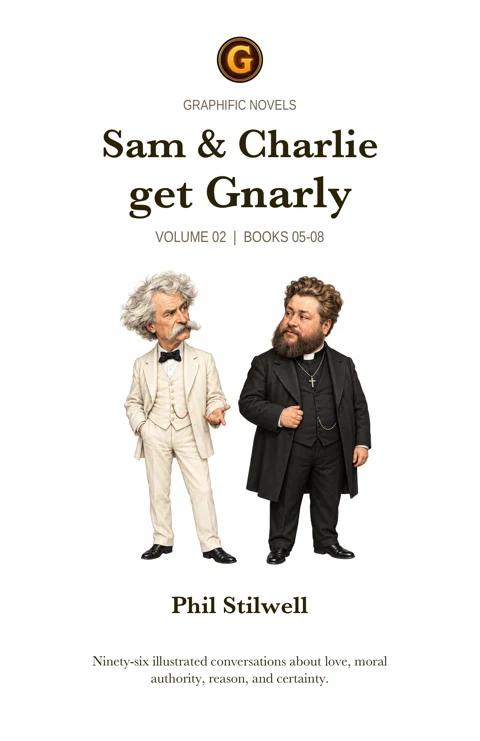
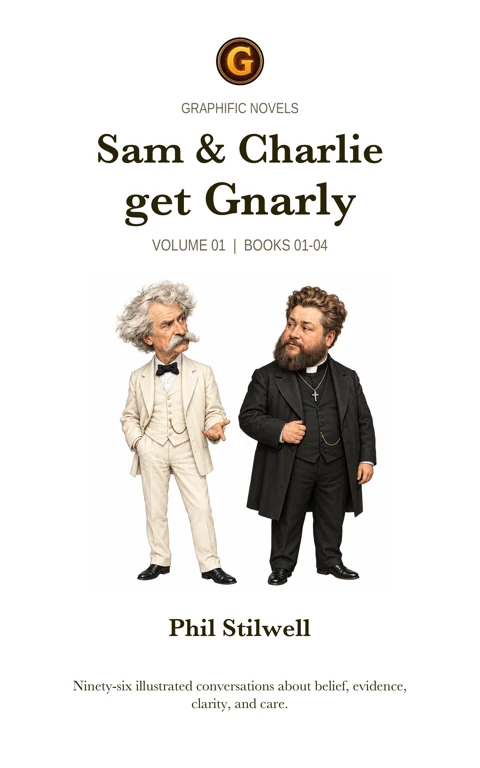
Sam asks what would make a religious claim trustworthy to someone who does not already believe it. Charlie speaks from commitment to scripture, providence, and a personal relationship with God. Their encounters turn large philosophical questions into conversations between two recognizable people, each with convictions worth understanding and assumptions worth examining.
Inspired by Samuel Clemens, better known as Mark Twain, and the preacher Charles Spurgeon, these companions inhabit imagined historical encounters. The dialogues are fiction, not recovered conversations or quotations. Riverboats, porches, streets, and railway platforms provide settings for disagreements that move from ordinary experiences of trust to the much larger claims made on behalf of divine authority.
Four stages of the inquiry
The Right to Question begins before the question of whether a belief is true. It asks whether a commitment may be examined at all. Familiar comparisons with promises, purchases, and leadership test the idea that the importance of an authority should place it beyond scrutiny. The discussion also asks whether words such as love and justice retain useful meaning when any possible conduct can be made to fit them.
The Hidden Author examines what makes a relationship personal. Prayer, conscience, nature, and spiritual experience enter the discussion, but identifying a particular communicating being remains a separate problem. The friends consider how someone could distinguish genuine contact from an interpretation supported mainly by prior belief.
The Problem of Clarity turns to religious communication. Disagreements about salvation, baptism, divorce, and leadership raise a practical question: does a message provide a dependable way to resolve uncertainty about its essential instructions? The distinction between an inspiring text and reliably intelligible guidance becomes central.
The Measure of Compassion connects claims about care with opportunities to help. Disease, sanitation, medical knowledge, and preventable suffering bring the discussion down to practical consequences. The focus is on whether the combination of knowledge, power, and love produces expectations that the evidence supports.
More than a sequence of comics
The volume collects Books 01–04, with ninety-six illustrated dialogues in total. Each comic has a concise summary, while the introductions and commentary explain the larger issue connecting the exchanges. Reflection questions make it possible to pause after an argument and identify its assumptions before moving on.
The accompanying discussion also draws boundaries around the conclusions. An unanswered question is not automatically a contradiction, and uncertainty about an explanation does not establish every skeptical alternative. Sam’s analogies and assumptions receive scrutiny alongside Charlie’s defenses.
A place to examine your own confidence
This is an accessible starting point for readers interested in faith, doubt, and the standards used to justify belief. Its illustrated format supports short reading sessions, while the commentary provides material for longer personal reflection or conversation with others. Readers need not share either character’s position to ask whether the reasons offered would persuade them in a different context.
Ready to turn the page?
Find this book on Amazon